


Hair Health During Menopause: A Complete Guide
Table of Contents
- Why Hair Health During Menopause Changes
- Menopause Hair Loss: Thinning, Shedding, and Texture Shifts
- Causes Beyond Menopause: What a Clinician May Consider
- A Hair Care Routine for Menopausal Hair
- Nutrition for Healthy Hair During Menopause
- Tracking Changes and Knowing When to See a Dermatologist
- Inside + Outside Support: What Supplements and Topicals Can and Cannot Do
- Conclusion: Building a Realistic Plan for Midlife Hair
- Frequently Asked Questions
Last Updated: November 1, 2026
Why Hair Health During Menopause Changes
Hair health during menopause depends on how shifting hormone levels interact with the hair growth cycle, the scalp, and the hair fiber itself. The transition does not damage hair directly; it changes the environment hair grows in.
A 2023 review by F. Rinaldi and colleagues on the menopausal transition and the hair follicle examined how menopause may relate to changes in the hair-follicle life cycle, with attention to hormonal and metabolic dynamics.
That framing matters. A lot of advice treats midlife hair changes as one problem with one fix. The research points to several overlapping factors instead.
Estrogen, Progesterone, and the Hair Cycle
The hair cycle is the repeating sequence of growth, transition, rest, and shedding that every follicle moves through. Estrogen and progesterone are among the factors associated with how long hair stays in its growth phase.
This is a gradual shift in timing, not a switch. Follicles do not stop working overnight, and changes vary widely from person to person.
Menopause Hair Loss: Thinning, Shedding, and Texture Shifts
Midlife hair changes can show up as diffuse thinning, more shedding, lower density, or texture changes rather than a single pattern. A 2025 review in Maturitas describes female-pattern hair loss and telogen effluvium as common in postmenopausal women, and frontal fibrosing alopecia as less common but potentially causing permanent hair loss.
That last point deserves attention. Not every midlife hair change is ordinary hormonal thinning, which is why evaluation matters when changes are unusual.
Dryness, Frizz, and Brittleness
Many women notice hair feeling drier, rougher, or more prone to breakage during the transition. Breastcancer.org's overview of menopausal hair changes notes that declining estrogen levels may be associated with shedding, thinning, texture changes, and dryness.
Frizz and brittleness usually reflect the hair fiber rather than the root. That distinction shapes what a routine can realistically help with.
Causes Beyond Menopause: What a Clinician May Consider
Hair changes during menopause should not automatically be attributed to menopause alone. Several causes can look similar, and sorting them out is a clinician's job, not a home checklist.
| Possible Cause | Commonly Described Pattern | Who Evaluates |
|---|---|---|
| Female-pattern hair loss | Gradual widening at the part, thinning over the crown | Dermatologist |
| Telogen effluvium | Diffuse shedding weeks after a trigger | Dermatologist or physician |
| Frontal fibrosing alopecia | Receding frontal hairline, scalp changes | Dermatologist |
| Thyroid-related changes | Diffuse thinning, often with other symptoms | Physician |
| Nutritional shortfalls | Diffuse shedding or brittle hair | Physician |
| Medication effects | Shedding after a new prescription | Prescribing clinician |
A Hair Care Routine for Menopausal Hair
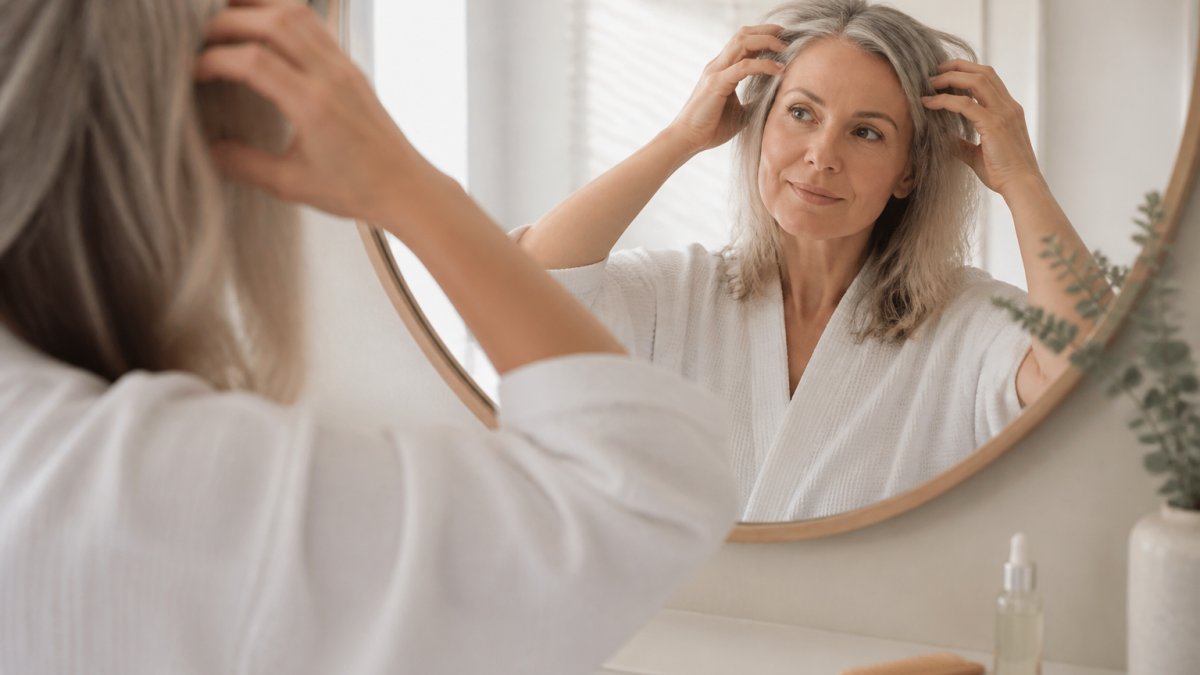
A hair care routine for menopausal hair should prioritize a comfortable scalp and protecting the hair fiber. Gentle handling preserves what is there while the scalp environment is supported.
Why the Hair Fiber and the Scalp Need Different Care
The visible hair fiber contains no living cells. Once a strand has grown out, nothing applied to it can rebuild its internal structure. What topical care can do is reduce friction, limit mechanical and chemical damage, and keep the scalp comfortable.
That is why a midlife routine splits into two jobs:
- Scalp care: keep the skin calm, clean, and comfortable.
- Fiber protection: reduce breakage so the hair you have looks fuller and holds length.
Shedding and density are largely about the growth cycle at the root. Breakage is about the fiber, and it is the part a routine can most directly influence.
A Practical Baseline Routine
- Cleanse the scalp with a mild shampoo, focusing on the scalp rather than the lengths. There is no universal wash frequency; wash when your scalp feels oily or uncomfortable.
- Condition mid-lengths to ends to reduce friction and breakage. If your scalp is oily, keep conditioner off the roots.
- Cleanse and massage with fingertips, not nails, and avoid vigorous scrubbing.
- Detangle damp hair with a wide-tooth comb, working from the ends upward. Wet hair stretches and snaps more easily.
- Limit heat styling and tight styles that pull on the hairline. When you use heat, keep the tool moving and use the lowest effective setting.
Adapting the Routine to Your Hair Type
- Textured and coily hair tends to be drier because natural oils travel less easily down the fiber. Cleansing less often, conditioning more generously, and detangling in sections can reduce breakage.
- Color-treated or chemically treated hair tends to lose moisture faster. Gentle cleansing and regular conditioning help maintain manageability.
- Protective styles such as braids, twists, and buns reduce daily handling, but only if they are installed and removed without tension. Tight edges and heavy extensions can contribute to traction-related damage.
Scalp Care and Gentle Styling
A calm, comfortable scalp is the foundation of any routine. Persistent itching, flaking, redness, tenderness, or burning are signs to check in with a dermatologist.
Loose styles, satin pillowcases, and low-tension braids reduce mechanical stress on fragile hair. Give your hairline a break between high-tension styles.
Nutrition for Healthy Hair During Menopause
Nutrition supports normal hair structure and maintenance, but thinner-looking hair does not prove a nutritional shortfall, and nutrition is not a substitute for medical evaluation.
Correcting a Shortfall Is Different From Supporting Normal Hair
There are two separate questions in hair nutrition, and they are often blurred together:
- Is there a nutrient shortfall? If a clinician identifies low iron or vitamin D, addressing it is part of medical care, not a supplement-shopping decision.
- Does a specific ingredient or formula support normal hair structure? That is a different claim, studied in different research, and it does not depend on being deficient.
Where a shortfall is suspected, a healthcare professional may recommend testing when clinically appropriate. Iron is a good example of why this matters: it is essential, but excessive intake can be harmful, so supplementation should reflect individual need.
What the Common Nutrients Do
- Protein: hair is made mostly of keratin, so adequate protein supports normal hair structure. This is about meeting needs, not megadosing.
- Iron: contributes to normal hair growth; intake should reflect individual need.
- Vitamin D: associated with the hair cycle in observational research, which is not the same as proof that supplementing changes hair.
- Biotin: essential, but deficiency is uncommon and high doses are not automatically better. High-dose biotin can also interfere with some lab tests, according to the FDA, so tell your clinician if you take it.
- Omega-3 fatty acids: studied for scalp and hair condition, with results that are not consistent enough to promise an outcome.
- Specialty ingredients: some, such as Cynatine HNS hydrolyzed keratin, have ingredient-level research. That research applies to the ingredient, group, and duration studied, not automatically to every finished product that contains it.
Setting Realistic Expectations
Hair grows about half an inch a month, so visible changes take months, not weeks, and results vary by person. Nutrition and specific ingredients may help support normal hair structure alongside a gentle routine and, where appropriate, professional evaluation. They are one part of the picture.
Tracking Changes and Knowing When to See a Dermatologist
When to see a dermatologist comes down to pattern, pace, and scalp symptoms. Slow, diffuse change over years is different from rapid shedding over weeks.
A simple tracking plan:
- Photograph the part and hairline monthly, in the same lighting and from the same angle
- Note general changes in shedding rather than exact counts
- Record scalp symptoms such as itching, burning, scaling, or tenderness
Seek evaluation for patchy loss, a receding frontal hairline, scalp inflammation, or shedding that persists for months without an obvious trigger. Bring your photos to the appointment.
Inside + Outside Support: What Supplements and Topicals Can and Cannot Do
Internal nutritional support and topical scalp care address different aspects of a hair-health routine and can be used as complementary approaches.
BENEGANIC USA builds its hair-health system around that split. The Keratin Hair Booster for Women 45+ combines Cynatine HNS keratin with vitamins, minerals, and plant-based ingredients to support normal hair structure and healthy-looking hair from within. The Intensive Hair Serum is a water-based scalp formula that leaves hair looking fuller and the scalp feeling comfortable. For a structured start, the 3-Month Reset System for Women 45+ pairs a 20-day kickstart phase with ongoing daily capsules.
Where these products fit: supporting hair nutrition, structure, and appearance, and a comfortable scalp. Where they do not: diagnosing or treating any medical cause of hair loss.
Conclusion: Building a Realistic Plan for Midlife Hair
Midlife hair changes are common, have more than one cause, and are rarely solved by one product. The work is in recognizing when something needs a dermatologist, then supporting the scalp and hair consistently.
BENEGANIC USA approaches that with an inside + outside philosophy: nutritional formulas that provide nutrients used in normal hair structure, and topical care for the scalp environment. Explore Hair Health Solutions to compare the options.
These statements have not been evaluated by the Food and Drug Administration. This product is not intended to diagnose, treat, cure, or prevent any disease. This article is educational and is not medical advice.
Frequently Asked Questions
Why does hair change during menopause?
Shifting estrogen and progesterone levels are associated with changes in the hair cycle, and many women notice changes in shedding, density, or texture during perimenopause and after menopause. The pattern varies widely, and not everyone notices changes. Because several conditions can look similar, a dermatologist can help distinguish hormonal shifts from other causes.
Is thinning or shedding after menopause always hormonal?
No. A 2025 review in Maturitas describes female-pattern hair loss and telogen effluvium as common in postmenopausal women, while frontal fibrosing alopecia is less common but can cause permanent hair loss. If you notice persistent or patchy loss, ask a dermatologist to evaluate it rather than assuming it is hormonal.
What nutrients support normal hair health during menopause?
Normal hair structure depends on adequate protein plus vitamins and minerals such as iron, vitamin D, and biotin. Thinner-looking hair does not prove a deficiency, and more is not automatically better. Iron should reflect individual need, and biotin deficiency is uncommon. A healthcare professional may recommend testing when clinically appropriate.
When should I see a dermatologist about hair changes during menopause?
Book an evaluation if shedding is sudden, persistent, or unexplained; if you notice patchy loss or a receding frontal hairline; or if you have scalp inflammation, itching, pain, or scaling. Do not stop or change any prescription medication on your own; speak with your healthcare provider first.
Can supplements or topical products help with menopausal hair changes?
They can provide nutrients used in normal hair structure and support a comfortable scalp, but they are not treatments for a hair-loss disorder. Research on specific ingredients does not automatically transfer to every finished product, and results vary. They do not replace medical evaluation when something else is driving the change.
Can menopause make hair dry, frizzy, or more fragile?
Texture changes are commonly reported during the transition, including dryness, frizz, and more breakage. Gentle handling helps: reduce heat styling, avoid tight styles that pull on the roots, and use a conditioner suited to your hair type.