


Why Premium Hair Supplements Cost More: Price Breakdown
Table of Contents
- Why Premium Hair Supplements Cost More: The Short Answer
- What Actually Drives the Price of a Hair Supplement
- Hair Supplement Ingredients: Where the Money Goes
- Third-Party Tested Supplements and Label Transparency
- Hair Growth Supplement Research: Does Price Track Evidence?
- Premium Versus Budget: A Cost-Per-Serving Breakdown
- Are Hair Supplements Worth It? A Decision Framework
- Conclusion
- Frequently Asked Questions
Last Updated: October 19, 2026
Why Premium Hair Supplements Cost More: The Short Answer
Premium hair supplements cost more because price reflects formulation choices, ingredient sourcing, testing, and brand positioning, not guaranteed results. A higher price tag buys a specific ingredient form, a stated dose per serving, and often third-party testing.
It is a fair question to ask of any brand, BENEGANIC included. Below is a breakdown of where the money goes, what the research does and does not support, and how to judge whether a premium hair supplement is worth it for your situation.
What Actually Drives the Price of a Hair Supplement
Four cost drivers explain most of the gap between a budget bottle and a premium one: the form of the ingredient, the dose per serving, testing and quality control, and the cost of the brand itself.
Ingredient form and bioavailability
The same nutrient can arrive in different chemical forms at very different costs. Chelated minerals, patented protein ingredients, and standardized botanical extracts typically cost more per kilogram than basic raw materials. Whether that premium translates into better outcomes depends on the specific ingredient and whether it has been studied in the form used.
Dose per serving versus label decoration
A label can list twenty ingredients and still deliver meaningful amounts of none of them. Premium formulas usually state doses per serving rather than hiding behind a "proprietary blend." The practical test is simple: compare the amount per serving against the amount used in published research on that ingredient, where such research exists.
Hair Supplement Ingredients: Where the Money Goes
Ingredient cost concentrates in a few categories. B vitamins, including biotin, and zinc are inexpensive commodity ingredients. Patented keratin peptides, standardized botanical extracts, and branded collagen ingredients carry licensing and manufacturing costs that basic vitamins do not.
That matters because biotin is essential for normal hair, but deficiency is uncommon, and higher doses are not automatically better. A premium price is rarely justified by biotin content alone.
Third-Party Tested Supplements and Label Transparency
Third-party testing is one of the clearest differences between budget and premium products, and one of the hardest for a shopper to verify. Testing for heavy metals, microbial contamination, and label accuracy adds cost per batch.
The FDA does not approve dietary supplements before they reach the market, and it does not certify that a product works. That makes independent verification more valuable, not less.
Hair Growth Supplement Research: Does Price Track Evidence?
Price and evidence are not the same thing, and the gap between them is where premium marketing does its most creative work. The useful question is not "is there a study?" but "what kind of study, on what, and how strong is it?"
Three tiers of evidence, ranked
Not all research on hair supplements carries the same weight. A practical ranking:
- Finished-product trials. A randomized, placebo-controlled study of the exact formula in the bottle. Strongest, but rare, most brands do not fund them, and the ones that exist are often small or product-funded.
- Ingredient-level trials. Research on a single ingredient, such as a specific keratin peptide or a standardized botanical extract, at a specific dose. Useful, but the results belong to that ingredient at that dose, not automatically to every formula that includes it.
- Mechanism and nutrient-status research. Studies showing that a nutrient is involved in normal hair structure, or that deficiency is associated with shedding. This supports the rationale for including an ingredient but does not prove a finished product changes hair outcomes.
A premium price is most defensible when a brand can point to tier-one or tier-two evidence for the specific ingredients and doses it uses. It is least defensible when the only support is tier-three rationale dressed up as proof.
What the published record actually shows
A 2023 systematic review in JAMA Dermatology looked across nutritional supplements studied for hair and found that the quality of evidence varies widely from ingredient to ingredient. The pattern across the literature is consistent: many small trials, few large independent ones, and frequent product funding.
An example of ingredient-level evidence: in a 90-day placebo-controlled trial, 50 women took Cynatine HNS, a hydrolyzed keratin, combined with vitamins and minerals, and showed statistically significant improvements in the measured hair and nail parameters compared with placebo. That finding applies to the studied ingredient formula, group, and duration, not automatically to every finished product that contains the ingredient.
How to read a supplement study in five minutes
When a brand cites a trial, check these before you trust the claim:
- Was it randomized and placebo-controlled? Without a control group, improvement is hard to attribute to the product.
- How many participants, and for how long? Small, short studies are more likely to produce flukes.
- What was measured? Self-reported satisfaction, hair counts, and hair diameter are different outcomes with different reliability.
The premium-evidence mismatch
Here is the uncomfortable truth the category rarely states plainly: a higher price does not reliably buy better evidence. Some premium brands fund original trials; others rely on ingredient-supplier research and marketing. Some budget brands use well-studied commodity ingredients at honest doses. Expensive does not mean proven. It means the manufacturer spent more on inputs, and possibly on research, but you have to check.
If you are weighing a premium formula against a budget one, ask the brand two questions: which finished-product trial, if any, was run on this exact formula, and which ingredient-level studies support each stated dose. A brand that can answer both is giving you something a price tag cannot.
Premium Versus Budget: A Cost-Per-Serving Breakdown
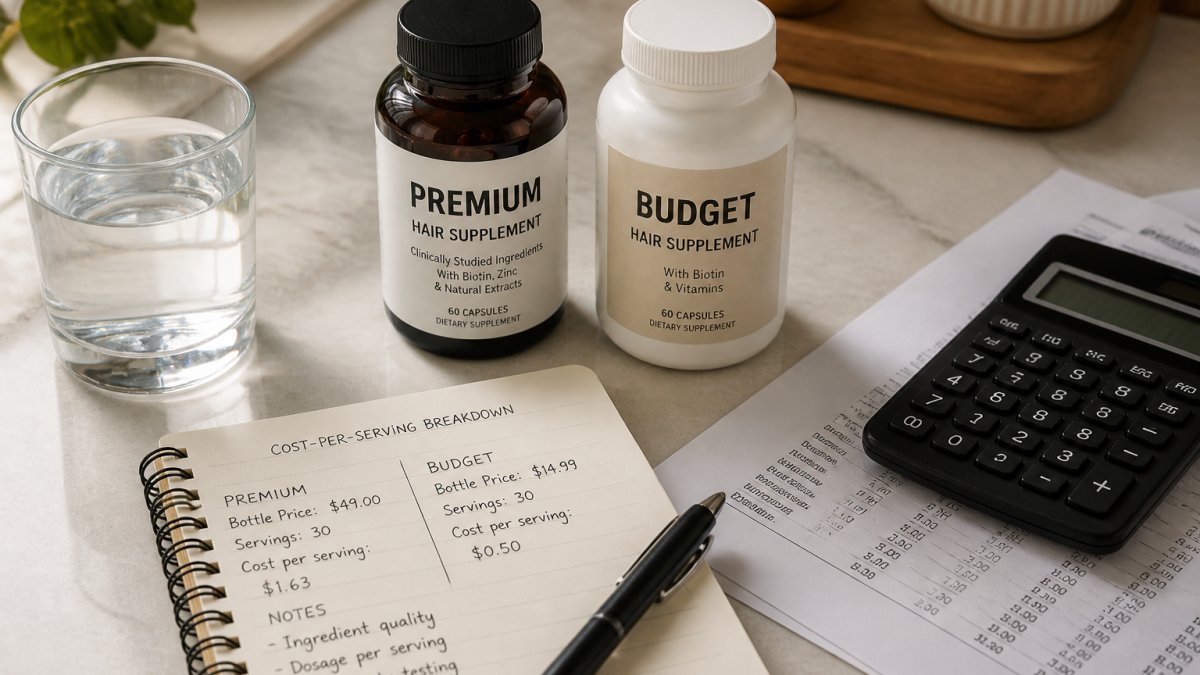
Sticker price is the least useful number on a supplement label. The only honest way to compare a premium hair formula against a budget multivitamin is cost per serving, cost per meaningful ingredient, and full-course cost.
The four numbers that actually matter
Before you compare two products, pull four figures off each label and each product page:
- Servings per container. A 60-capsule bottle taken at two capsules daily is a 30-day supply, not a 60-day supply.
- Price per container. Use the regular price, not a first-order discount or promotional credit.
- Cost per serving. Divide price by servings. This is the only apples-to-apples number.
- Full-course cost. Multiply by the number of months you realistically plan to take it.
A worked example, using only label math
You do not need a specific brand to see how the math changes the ranking. Take two hypothetical products:
| Budget multivitamin | Premium hair formula | |
|---|---|---|
| Price per container | $12 | $60 |
| Capsules per container | 60 | 60 |
| Serving size | 2 capsules | 2 capsules |
| Servings per container | 30 | 30 |
| Cost per serving | $0.40 | $2.00 |
| Cost per 30 days | $12 | $60 |
| Cost per 90 days | $36 | $180 |
| Stated dose per ingredient | Often blended | Usually listed |
| Ingredient form | Basic | Patented or standardized |
| Third-party testing | Rarely published | More common |
The premium formula costs five times more per serving. That is the real premium, not the $48 difference on the shelf. Whether that five-times multiplier is justified depends entirely on what the extra money buys: a stated dose of a studied ingredient form, documented testing, and a formula matched to your situation. If it buys none of those, the multiplier is branding.
The subscription trap
Recurring billing is where full-course cost quietly balloons. A subscription that ships every 30 days at $60 per bottle is $720 per year, whether or not you finish each bottle. Three questions to ask before you subscribe:
- Can you pause or cancel without a fee? If not, the annual cost is locked in.
- Does the subscription price differ from the one-time price? A discount that only applies to the first shipment is not a discount on the course.
- Does the serving size match the shipping interval? A 60-serving bottle shipped monthly means you are buying twice what you use.
Full-course cost, not first-bottle cost
Hair grows about half an inch a month, so any supplement needs at least three months of consistent daily use before you can judge it. That means the number that matters is the cost of a realistic course, not the cost of one bottle.
Are Hair Supplements Worth It? A Decision Framework
Whether a hair supplement is worth it depends on why your hair is changing, not on how much the bottle costs. Use this framework before you buy.
- Has a clinician evaluated sudden, patchy, or persistent shedding? Do this first.
- Is there a diagnosed or suspected nutrient shortfall? A professional may recommend testing when appropriate.
- Does the label state doses per serving for each ingredient?
If shedding is sudden, persistent, or patchy, or if you have a medical condition, see a dermatologist or qualified healthcare professional before self-treating with supplements. Nutrition support and topical care can complement a healthy routine, but they are not a substitute for diagnosis.
The FDA's dietary supplement guidance is clear that these products are not intended to diagnose, treat, cure, or prevent disease, and that framing should guide how you read any premium price.
Conclusion
The harder question is not whether premium hair supplements cost more, but whether the extra spend buys something you can verify: a stated dose, a studied ingredient form, and documented testing. That is the standard worth paying for.
BENEGANIC USA formulas are built around Cynatine HNS keratin and produced to GMP at pharmaceutical level in a family-run Swiss company. Explore Hair Health Solutions to compare the range and see the details for yourself.
These statements have not been evaluated by the Food and Drug Administration. This product is not intended to diagnose, treat, cure, or prevent any disease. This article is educational and is not medical advice.
Frequently Asked Questions
Why are some hair supplements more expensive than others?
Price differences usually come down to four things: the form of each ingredient, the dose per serving, how many ingredients are included, and whether the finished product is third-party tested. Patented ingredients such as Cynatine HNS keratin cost more than commodity biotin or zinc, and a formula with ten or more ingredients carries higher material and manufacturing costs. Packaging, subscription structure, and brand positioning add to the total. None of these factors on its own proves a supplement works better, which is why comparing cost per serving alongside the label is more useful than comparing sticker prices.
Are premium hair supplements worth the extra cost?
Sometimes, but not automatically. A higher price can reflect a more bioavailable ingredient form, a meaningful dose, and independent testing, all of which are worth paying for if the formula matches your situation. It can also reflect marketing and packaging. The practical test is to divide the price by the number of servings, then check whether the ingredients and doses you care about are actually disclosed. If a budget product lists the same ingredient forms at the same doses with a certificate of analysis, the premium version has little to justify the gap.
What does third-party testing mean for supplements?
Third-party testing means an outside laboratory, not the manufacturer, checks the product for identity, potency, and contaminants such as heavy metals or microbes. In the United States, the FDA does not approve dietary supplements before they are sold, so independent testing is one of the few external checks a buyer can look for. A certificate of analysis should name the batch and the tests performed. Testing confirms what is in the bottle, not that the formula will produce a particular hair outcome, so treat it as a quality signal rather than proof of results.
Can a hair supplement's ingredient research prove that the finished product works?
No. Research on a single ingredient, such as a placebo-controlled study of a specific keratin, tells you about that ingredient in that population and dose. It does not transfer automatically to a finished product that combines that ingredient with others at a different dose. Reviews of the research are a useful reminder that the evidence base for finished formulas is thinner than for individual nutrients. Ask whether the research cited matches the exact formula you are buying.