


How to Verify Supplement Purity Before You Buy
Last Updated: November 15, 2026
Quick Summary
To verify supplement purity, read the Supplement Facts panel for specific ingredient amounts, check for a complete manufacturer address and lot number, and confirm any third-party seal in the certifier's own online directory rather than trusting the bottle. Buy only from authorized sellers and check batch codes close to purchase.
- A proprietary blend without disclosed amounts gives you no way to compare a product to research.
- Search the USP's own listing instead of trusting a seal printed on a bottle.
- NSF certification confirms contents match the label, not that a product improves hair.
- Check recall databases and certification directories close to the date of purchase.
- Hair grows about half an inch per month, so allow at least three months before judging a routine.
Table of Contents
- What Supplement Purity Means and Why It Matters
- Step 1: Read the Label for Purity Clues
- Step 2: How to Find USP Verified Supplements
- Step 3: What NSF Certified Supplements Tell You
- Step 4: Use a Supplement Checker Website
- Step 5: How to Check Supplement Authenticity
- What Pure Supplements Can and Cannot Do for Hair
- Building Your Inside and Outside Hair Routine
- Frequently Asked Questions
What Supplement Purity Means and Why It Matters
Supplement purity is the degree to which a product contains exactly what its label states, in the amounts listed, without harmful contaminants, fillers, or undeclared ingredients. For anyone learning how to verify supplement purity, the stakes are simple: a label is a promise, and testing is how that promise gets checked.
That promise matters more for hair supplements than for many other products. Hair-support formulas often combine several vitamins, minerals, and specialty ingredients, which means more opportunities for a label to drift from reality. The FDA's consumer guidance on dietary supplements notes that supplements are regulated more like food than like drugs, so quality depends heavily on the manufacturer's own controls.
Here is the uncomfortable truth most buying guides skip: a product can be legal, widely sold, and still not match its label. Independent verification exists to close that gap.
Step 1: Read the Label for Purity Clues
Start with the Supplement Facts panel. It should list every active ingredient with a specific amount, not a vague "proprietary blend" that hides doses.
Next, check the other ingredients line for fillers, artificial colors, and flow agents. Fewer unnecessary additives generally means fewer unknowns.
Look for these label elements:
- A complete manufacturer name and physical address
- A lot number or batch code
- An expiration or "best by" date
- Clear allergen statements
- A third-party seal, if one exists
Watch out: a label that lists a blend without amounts gives you no way to compare it to anything, including the research. For a deeper walkthrough of label red flags, see this guide to hair nutraceutical safety standards.
Step 2: How to Find USP Verified Supplements
The fastest way to find USP Verified supplements is to search the U.S. Pharmacopeia's own listing rather than trusting a seal printed on a bottle. A seal can be photographed and copied; the official database cannot.
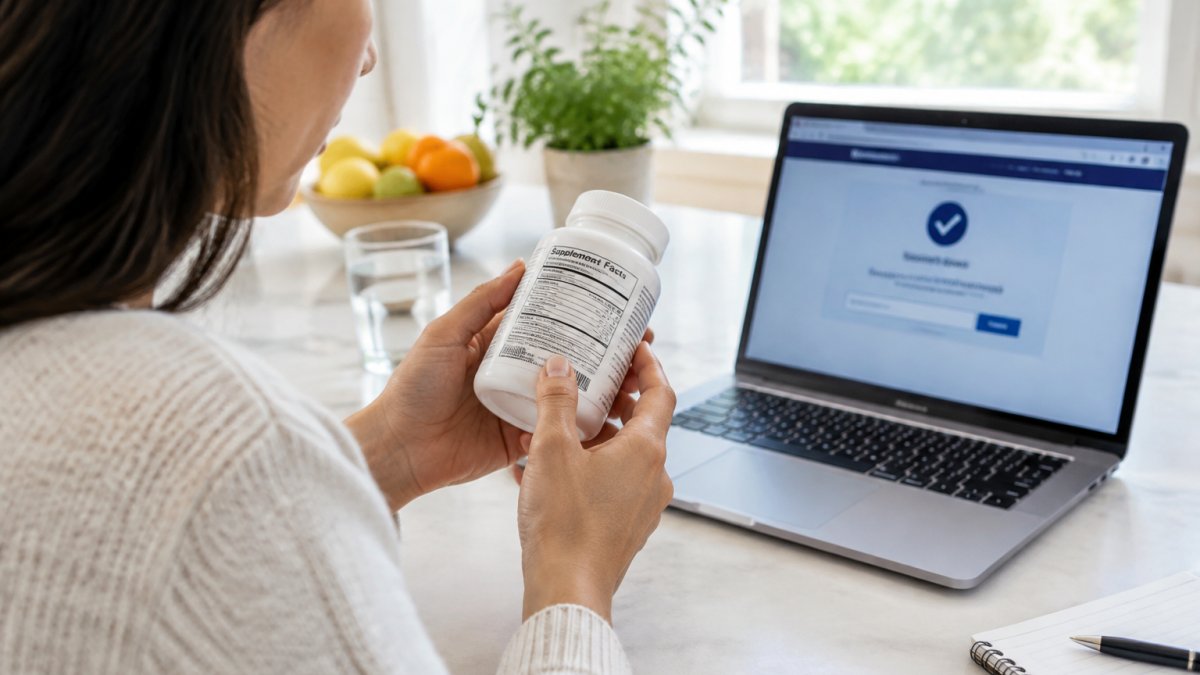
The USP Dietary Supplements Verification Program describes testing and auditing designed to evaluate whether submitted products meet its requirements. That covers identity, potency, and certain contaminants.
One caution: verification speaks to quality, not to whether a product works for hair. If the distinction between a quality seal and a clinical claim confuses you, this explanation of clinical grade hair vitamins helps separate the two before you buy.
Step 3: What NSF Certified Supplements Tell You
NSF Certified supplements have been tested in accredited laboratories to confirm that the contents match the label. That is the core of the program, and it is worth understanding precisely.
According to the NSF dietary supplement certification program, product testing checks whether a supplement's actual contents match what is printed on its label. Nothing more, nothing less.
So what does that mean in practice?
- The label and the bottle should agree
- Facilities are typically audited as part of certification
- The mark does not prove the product improves hair
That last point trips people up. A certification answers "is this what it says it is," not "will this help." For the science behind what ingredients can and cannot do, this breakdown of the science behind hair growth supplements covers the evidence side.
Step 4: Use a Supplement Checker Website
A supplement checker website lets you look up a product, a brand, or a certification before you spend money. Think of it as a background check for the bottle in your hand.
Useful places to check include:
- The USP and NSF product directories
- The FDA's recall and warning letter databases
- The manufacturer's own certificate of analysis, when published
A common mistake is treating one clean search result as a full clearance. Recalls and certifications change. Check close to the date of purchase, not once a year.
Step 5: How to Check Supplement Authenticity
Checking supplement authenticity means confirming three things: the product is genuine, the seller is authorized, and the batch is current. Skip any one and the other two mean little.
Start with the seller. Buying from an unauthorized marketplace seller raises the risk of expired, repackaged, or counterfeit stock. Then check the batch code against the manufacturer's records if they offer that service.
Red flags worth taking seriously:
- A price far below every other seller
- Packaging with typos or mismatched fonts
- No lot number anywhere on the bottle
- A seal that looks printed rather than applied
For a practical list of what separates a trustworthy formula from a convincing imitation, this guide to hair growth supplements that actually work is a useful cross-check.
What Pure Supplements Can and Cannot Do for Hair
Purity is a baseline, not a benefit. A pure supplement is one you can trust to contain what it claims; it is not automatically one that changes your hair.
What a well-made supplement can do is supply nutrients used in normal hair structure and maintenance, particularly when a person's diet falls short. What it cannot do is override genetics, hormonal shifts, or a medical condition driving shedding.
The American Academy of Dermatology's guidance on hair loss is clear that many types of shedding have causes a supplement will not touch, including thyroid issues and autoimmune conditions. Sudden, patchy, or persistent loss deserves a dermatologist's evaluation, not another bottle.
Set realistic timelines, too. Hair grows about half an inch per month, so allow at least three months of consistent use before judging any routine.
Building Your Inside and Outside Hair Routine
An inside and outside routine pairs nutritional support with scalp and hair care, and it works best when both sides are held to the same quality standard. That means applying the same label scrutiny to a capsule that you apply to a topical product.
Here is a simple comparison to keep the priorities straight:
| Check | What It Confirms | Where to Look |
|---|---|---|
| Third-party seal | Label matches contents | USP or NSF directory |
| Ingredient amounts | Doses are disclosed | Supplement Facts panel |
| Lot and expiry | Batch is current | Bottle base or side |
| Seller authorization | Product is genuine | Brand's own store |
| Certification scope | What was actually tested | Certifier's website |
The same questions apply to any brand, BENEGANIC USA included: what is in the product, how much, and how it is made. The BENEGANIC Keratin Hair Booster range and the 20-Day Intensive Hair Care Keratin Reset are built around Cynatine HNS, a hydrolyzed keratin, with GMP production at pharmaceutical level in a family-run Swiss company. In a 90-day placebo-controlled trial, 50 women took Cynatine HNS, a hydrolyzed keratin, combined with vitamins and minerals, and showed statistically significant improvements in the measured hair and nail parameters compared with placebo. That finding applies to the studied ingredient formula, group, and duration, not automatically to every finished product that contains the ingredient.
Best for: adults who want a structured inside and outside routine with disclosed ingredients. Skip if: you are experiencing sudden or patchy loss, which calls for a dermatologist first.
Purity checks are a practical first step before committing to a routine. BENEGANIC USA offers hair supplements and topical scalp care built for a complementary inside and outside approach. Explore Hair Health Solutions and start with a routine you can actually verify.
These statements have not been evaluated by the Food and Drug Administration. This product is not intended to diagnose, treat, cure, or prevent any disease. This article is educational and is not medical advice.
Frequently Asked Questions
How do I check the purity of a supplement?
Start by reading the Supplement Facts label to confirm the serving size and that the ingredient amounts match the front-of-bottle claims. Look for a third-party seal such as USP Verified or NSF Certified, which indicates the product was tested and audited against quality requirements. You can also search the certifier's website to confirm the product is listed. Check the expiration date and storage instructions, and buy from established retailers rather than unfamiliar sellers. If a product makes disease claims or lists no manufacturer, treat that as a warning sign.
What is the difference between USP and NSF supplement certification?
USP's Dietary Supplement Verification Program involves testing and auditing to evaluate whether submitted products meet its requirements. NSF says its product testing in accredited laboratories checks whether a supplement's actual contents match what is printed on the label. Both are third-party programs that focus on product contents, testing, auditing, and quality requirements. Neither certification reports clinical outcomes, so a seal tells you about quality processes, not whether the supplement will work for a particular health goal.
Does third-party certification prove a supplement will work?
No. Certification marks and verification programs provide evidence about product quality, but the available information does not establish that certification proves effectiveness for a particular health outcome. The verification descriptions concern product contents, testing, auditing, and quality requirements rather than clinical results. For hair health, judge a product on its ingredients and the evidence behind them, and allow at least three months of consistent use before deciding whether a routine is worth continuing.
How can I check supplement authenticity and avoid counterfeit products?
Buy from the brand's official website or a reputable retailer, and avoid marketplace listings from unfamiliar sellers. Compare the packaging you receive with the brand's official images, including the label layout, lot number, and expiration date. Look for a tamper-evident seal that is intact. Use the certifier's website to confirm any third-party seal is real, and contact the manufacturer directly if a lot number or label detail looks inconsistent. Keep your receipt so you can report a problem if needed.
