


Can You Stop Thinning Hair Naturally? What the Evidence Shows
Table of Contents
- Thinning or Shedding? Why the Difference Matters
- Natural Remedies for Thinning Hair: What the Evidence Actually Shows
- Vitamins for Thinning Hair: What Supports Normal Hair Health
- Scalp Care for Thinning Hair: Building a Gentle Routine
- Tracking Your Hair Changes
- When to See a Dermatologist
- Inside + Outside Support: Where Nutrition and Topical Care Meet
- Frequently Asked Questions
Last Updated: October 15, 2026
Thinning or Shedding? Why the Difference Matters
Can you stop thinning hair naturally? The honest answer is that natural approaches can support a healthy scalp and normal hair, but no natural remedy can reliably stop every kind of thinning. What helps depends on what is actually happening, and the first useful question is whether hair is thinning gradually or shedding more than usual.
This guide covers what the evidence supports, what it does not, and when to get professional help.
Sudden Shedding vs. Gradual Thinning
Increased shedding often shows up weeks after stress, illness, childbirth, or another major change, with more hair in the drain but no bare patches.
Gradual thinning usually develops over months or years, with a wider-looking part or more visible scalp near the crown.
The two can overlap, and neither pattern on its own identifies a cause.
When to Start With a Professional
Some situations call for a clinician before any home approach:
- Patchy or smooth bald spots
- Shedding alongside fatigue, weight change, or menstrual changes
- Scalp pain, itching, scaling, or redness
- Gradual thinning that keeps progressing, especially with a family history, since a dermatologist can discuss the full range of options
- Shedding that persists or worsens after the triggering event has passed
Natural Remedies for Thinning Hair: What the Evidence Actually Shows
Natural remedies for thinning hair are not all equal. A few have been studied in small trials, many rest on preliminary research, and some are traditional favorites with little clinical backing.
Popular botanical options such as rosemary oil, pumpkin seed oil, and onion juice have a limited research base, mostly small studies that are hard to generalize. That does not mean they are useless; it means the honest answer is that the evidence is still thin.
Device-based and in-office procedures, such as low-level light therapy and microneedling, are areas of ongoing research described in reviews such as this 2024 overview in PubMed Central. These are best discussed with a dermatologist, who can explain which options fit your situation.
Safety and Who Should Be Cautious
Natural does not automatically mean risk-free:
- Essential oils should be diluted before scalp use. Undiluted oils can cause irritation or allergic reactions. Follow product directions and stop if irritation occurs.
- Pregnancy and breastfeeding: check with a healthcare professional before using botanical products, including rosemary and saw palmetto.
- Medications: some oral botanicals can interact with prescription medications. Ask a pharmacist or physician before adding them.
What Natural Approaches Can and Cannot Do
Natural approaches may help support a healthy scalp environment and normal hair health. They are not a treatment for a hair-loss disorder and do not replace the options a dermatologist may recommend. If thinning is progressive, a natural remedy alone is unlikely to change the underlying pattern.
Vitamins for Thinning Hair: What Supports Normal Hair Health
Hair is built from protein and depends on nutrients such as iron, zinc, vitamin D, and B vitamins. A shortfall in any of these can affect hair quality, and making up a shortfall is one reason nutrition matters.
Separately, some specific nutraceutical ingredients and formulas have been studied for hair-related outcomes in defined groups. That is a different kind of evidence from correcting a deficiency, and results from one study should not be generalized to every supplement.
More is not automatically better:
- Iron should reflect individual need, because excessive intake can be harmful
- Biotin is essential, but deficiency is uncommon and high doses are not automatically helpful
- Thinner-looking hair does not prove a deficiency is present
A balanced diet covers most needs. Supplements can fill gaps, but they are not a substitute for a varied diet or medical care. (Source: the American Academy of Dermatology)
Scalp Care for Thinning Hair: Building a Gentle Routine
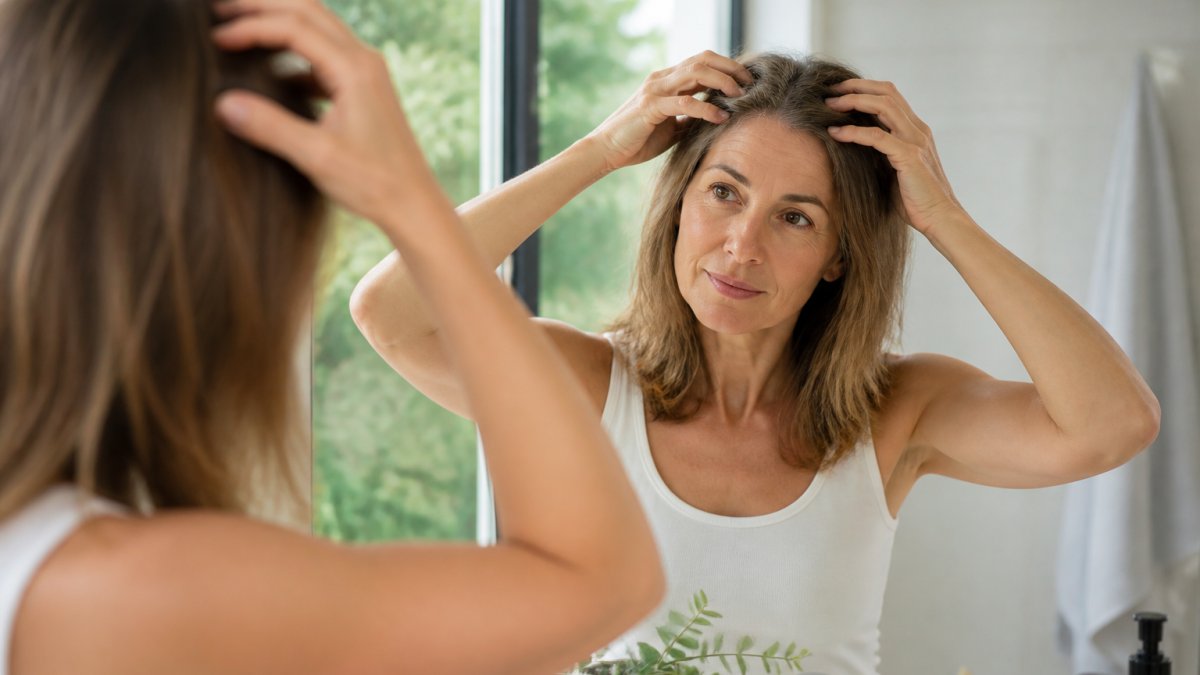
Scalp care focuses on keeping the scalp environment comfortable and handling hair gently. It is supportive, not curative: it removes avoidable obstacles to healthy-looking hair without changing a medical cause of thinning.
- Wash with a mild shampoo and warm, not hot, water
- Cleanse the scalp with fingertips, not nails
- Avoid tight hairstyles, harsh brushing, and frequent chemical treatments
- Detangle from the ends upward with a wide-tooth comb, and be gentle with wet hair
There is no single correct wash frequency. The right rhythm depends on scalp oiliness, activity level, and product use.
Scalp massage feels good and may support a comfortable scalp environment, but evidence for its effect on hair density is limited. Treat it as a pleasant habit, not a treatment.
Tracking Your Hair Changes
Tracking turns guesswork into information and gives a dermatologist useful context.
- Take photos in the same light, from the same angle, once a month.
- Note noticeable changes in shedding or scalp comfort.
- Record major health, medication, or lifestyle changes.
- Bring the record to a professional if changes persist.
When to See a Dermatologist
See a dermatologist for hair loss that is sudden, patchy, persistent, or accompanied by scalp symptoms. A professional can look for causes that self-care cannot address, may recommend testing when it is clinically appropriate, and can discuss medical options if they fit your situation.
Inside + Outside Support: Where Nutrition and Topical Care Meet
Hair health has two sides. Topical care supports the scalp and the hair you can see. Nutrition supplies the building blocks the body uses to form new hair at the root.
Internal nutritional support and topical scalp care address different aspects of a hair-health routine and can be used as complementary approaches. That is the idea behind the BENEGANIC USA inside + outside approach.
Hair changes slowly, and no single step fixes everything. A calm scalp routine, a balanced diet, gentle handling, and a clear record of changes are realistic foundations. When something looks sudden, patchy, or persistent, a dermatologist is the right next call.
These statements have not been evaluated by the Food and Drug Administration. This product is not intended to diagnose, treat, cure, or prevent any disease. This article is educational and is not medical advice.
Frequently Asked Questions
Can thinning hair be stopped naturally?
Not reliably. Natural approaches can support a healthy scalp and normal hair health, but they are not proven to stop every type of thinning. What helps depends on the cause. If thinning is sudden, persistent, patchy, or accompanied by scalp symptoms, a dermatologist can assess whether a medical cause needs attention.
Do natural remedies for thinning hair have strong evidence?
Mostly not yet. Botanicals such as rosemary oil, pumpkin seed oil, and onion juice have limited or mixed research, mostly small studies. Device-based and in-office procedures are areas of ongoing research that are best discussed with a dermatologist. Set realistic expectations for any approach.
Can diet affect thinning hair?
Nutritional shortfalls in protein, iron, zinc, and vitamin D are associated with hair changes, and a balanced diet supports normal hair structure. Thinner-looking hair does not automatically mean a deficiency, and high doses are not automatically better. A healthcare professional may recommend testing when clinically appropriate.
When should I see a dermatologist about thinning hair?
See a dermatologist or qualified healthcare professional if hair loss is sudden, persistent, unexplained, or patchy; if you notice scalp pain, itching, or inflammation; or if hair changes come with other symptoms or follow a new medication. Early evaluation helps identify the cause.
For those who want to support hair from both sides, BENEGANIC USA offers an inside + outside approach built on selected nutrients and topical scalp care.